Top 10 Tips On How To Establish The Regularity Of Testing For PAT in Hinckley
Determining the correct frequency for Portable Appliance Testing (PAT) is one of the most common and critical challenges for dutyholders under UK health and safety law. Contrary to widespread misconception, there is no mandated statutory interval–such as an annual requirement–specified in the Electricity at Work Regulations 1989. Instead, Regulation 4(2) imposes a general duty to maintain electrical systems to prevent danger, placing the legal onus on the employer or responsible person to establish a suitable maintenance regime through a structured risk assessment. The Health and Safety Executive strongly endorses this risk-based approach. It moves away from blanket test schedules and demands a documented, reasoned justification for all testing and inspection intervals. The frequency must be proactively determined by evaluating the type of equipment, its operating environment, its users, and its previous history, making PAT scheduling a dynamic process rather than a passive, calendar-based compliance exercise.
1. The Absolute Primacy of Risk Assessment
The frequency of testing is not prescribed by law but must be derived from a suitable and sufficient risk assessment conducted by the dutyholder. This assessment will be the foundation for all your PAT tests. The assessment should take into consideration all factors that might cause an appliance or device to become unsafe and then determine the frequency of testing and/or inspection to mitigate this risk. HSE inspectors will look for this assessment, and they will compare it to the conclusions. A testing schedule without this assessment is potentially non-compliant.
2. Key Factors Influencing Testing Intervals
The risk assessment must systematically evaluate several core factors to determine a defensible frequency. These include: Equipment Type: Class I appliances (e.g., kettles, toasters, power tools) require more frequent testing than Class II (double-insulated) appliances due to their earth reliance. A harsh environment, such as a commercial kitchen, construction site, or workshop, requires far more frequent inspections than a calm office. Equipment that's used by well-trained employees might need less testing than equipment for the general public. Appliance construction: More robust equipment is less likely to be a risk. Prior History: Appliances with a fault history will need more frequent checks.
3. The Role of Formal Inspections
Formal visual inspections can be a legal part of the maintenance program and are often more valuable than inspections and testing combined. These inspections can be used to identify most faults. For example, cable damage, damaged casings, loose plugs and contamination. In many cases, for low-risk appliances and environments (e.g. a desktop computer at an office), all that may be required is a formal inspection by a person with the necessary expertise. No need to perform routine electronic tests. Risk assessment also determines the frequency of these formal checks.
4. User Checks and First Line Maintenance
The first line of defense is the user check. The dutyholder is responsible for encouraging users to do a visual pre-use check, including looking out for signs of damage like frayed cables, burned marks, or loose components. Although not part of the formal system of PAT, promoting user awareness can be a vital part of an holistic risk-based strategy and help identify issues between scheduled formal inspections.
5. Code of Practice of IET – Guidance
It is important to note that the IET Code of Practice does not constitute law. However, it offers valuable guidance as to recommended first frequencies. The table offers intervals for various types of equipment in different environments. The table can serve as a starting point in the risk assessment of duty holders. This table might recommend 3-monthly inspections of equipment at a construction site, but 24-monthly for the IT equipment used in offices. These recommendations are preliminary and will be modified according to actual experience.
6. The Concept of "Result Based Scheduling"
The results of the previous tests can be used to adjust future test frequencies. If a particular appliance, or group of appliances, has consistently passed its tests over several years without error, a risk assessment may be conducted to justify increasing the testing interval. Conversely, if a particular type of appliance frequently fails, the interval should be shortened. Enforcing authorities look favourably on this dynamic approach based on evidence.
7. New Appliances, Equipment and Products
A common myth is that new equipment does not require testing. While it may not need a formal combined test before first use, a formal visual inspection is still required to check for transit damage, correct wiring of the plug, and suitability for the UK market (e.g., a correctly fused plug). The risk analysis will determine when to test new equipment. It will be integrated into the maintenance schedule.
8. Renting or Borrowing Equipment
Equipment brought onto the premises, such as hired tools or equipment used by contractors, must be included in the PAT system. It's the dutyholder who has to check that the equipment will be safe before it is used. Risk assessments for this equipment are often conservative and require a combined inspection/test immediately prior to its first use.
9. Documenting the rationale for selected frequencies
Documentation is required to demonstrate compliance. The risk assessment must not only state the chosen frequency for each type of appliance but must also record the rationale behind that decision. This document is proof of "due due diligence." This document should list the factors to be considered (environment type, user, and equipment type), as well as, if appropriate, reference the IET Code of Practice.
10. Reviewing and Adjusting Intervals on a Regular Basis
The risk assessment and the testing frequencies it dictates are not static documents. Regulation 4 in the Electricity at Work Regulations of 1989 states that maintenance must be performed continuously. The dutyholder has to review the risks and the effectiveness testing intervals at regular intervals (e.g. once a year) or whenever there is a significant change. This will ensure that the system is effective and proportionate. View the top Hinckley EICR inspections for site examples including fire and extinguisher, electrical fire, a fire extinguisher, fire extinguisher servicing, fire service fire extinguisher, extinguisher fire extinguisher, fire extinguisher inspections, fire extinguisher for electrical fire, fire extinguisher extinguisher, fire extinguisher using and more..

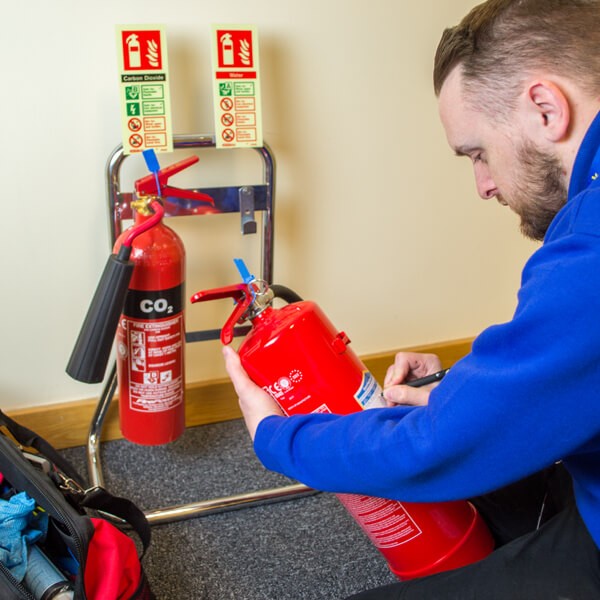
Top 10 Tips For The Regulatory Compliance For Fire Extinguisher Service in Hinckley
The UK's regulatory framework on fire extinguisher maintenance is an entire approach to protect the public and ensure equipment reliability by clearly defining requirements, technical standards and certification programs. Service for fire extinguishers is controlled by the Regulatory reform (Fire Safety) Order, which provides specific legal requirements. This order is supported by standards of technical excellence and certification programmes from third-party organizations that offer a structured PAThway for compliance. This multilayered approach puts the primary responsibility for maintaining a building on "the responsible person". It also provides standards for the demonstration of diligence. This framework is essential in ensuring compliance with legal requirements and to ensure that fire safety equipment performs according to the standards required in emergency situations.
1. The Regulation Reform (Fire Safety) Order 2005 (FSO) in Hinckley
This legislation forms the foundation of the law on fire safety in England and Wales as well as similar regulations being enacted in Scotland (Fire Scotland Act 2006) and Northern Ireland. The article 17 stipulates that "all firefighting equipment must be subject to a program of maintenance, and maintained in a condition where it is in optimal working order and good repair." The Order delegates responsibility to "Responsible people" (typically owners, employers or occupiers of buildings) to establish and maintaining proper maintenance regimes.
2. British Standard BS 5306-3 : 2017
This standard provides an technical framework that is in line with the FSO. It details the requirements for commissioning and maintaining portable extinguishers. It outlines three types of services that are available which are basic (annual visual inspections and easy checks) and advanced (discharge testing and internal inspections every 5 years for water, powder and foam extinguishers) and overhaul (pressure tests and internal inspection every 10 years). The BS 5306-3 standard can be used as a benchmark to show an "suitable" maintenance system in accordance with the law.
3. Third-Party Certification Schemes (BAFE SP101) in Hinckley
Although not legally required, an organization that is BAFE (British approvals for fire equipment) SP101 certified offers the most convincing evidence of due diligence. This UKAS accredited certification scheme independently confirms a business's conformance to stringent standards in terms of technician competency, work quality and equipment. BAFE Certification is accepted as a strong proof to fire authorities, insurers and courts that an organization has met the FSO’s maintenance requirements.
4. Fire Risk Assessment – What's the purpose? in Hinckley
Fire Risk Assessments (FRAs) are dynamic documents that guide every fire safety decision, including those relating to extinguisher service. The Fire Risk Assessment (FRA) should specify the nature, size and Hinckley of equipment for fighting fires as well as the requirements for its maintenance. The FRA should be reviewed on a regular basis particularly when the circumstances change. Any changes must be included in the service schedule. The service reports that are provided by providers can be an excellent source of useful data.
5. Documentation and proof requirements in Hinckley
It is crucial to provide detailed documentation to prove the compliance. Following every service, the provider should issue a report that contains the company's information as well as the engineer's contact information and service dates, a list and description of services performed, equipment, and any identified faults. These documents must always be accessible to the authority in charge of enforcement (Fire and Rescue Services), and insurers. You are able to take enforcement action in the event that you don't have the proper documentation even if the services were provided.
6. The Mechanisms for Enforcement of Penalties in Hinckley
Local Fire and Rescue Authorities perform compliance audits and have significant authority to enforce. For non-compliance with servicing requirements They can issue Alterations Notices (requiring changes to the fire safety measures), Enforcement Notices (mandating specific changes within a set timeframe), and in serious cases, Prohibition Notices (restricting or closing premises immediately). In serious cases, the courts can impose unlimited penalties and imprisonment of up to two years for violating the law.
7. Risks of insurance in Hinckley
Commercial insurance policies typically include the requirement of compliance with the fire safety law. Insurance coverage can be invalidated by inadequate servicing records or providers that are not compliant following a major fire. Insurance assessors frequently require documentation on servicing when they process claims. Insurers might also need certain certification standards (like the BAFESP101) to be met in order to qualify for coverage.
8. Technical Competence Requirements for Technicians in Hinckley
The FSO requires maintenance to be performed by an "competent individual." While not legally defined, competence generally includes: formal training on BS 5306-3, manufacturer-specific equipment training, practical experience, and understanding of relevant regulations. Third-party programs like BAFE SP101 give the best assurance of technician proficiency through periodic assessments and audits.
9. Environmental Compliance (Duty of Care) in Hinckley
Environmental legislation regulates the correct disposal of extinguishers that have been decommissioned and other garbage. This includes, in particular, the Environmental Protection Act (1990). Service providers must be registered waste haulers and issue Waste Transfer Notes (WTNs) for the disposed equipment. Responsible individuals should make sure their provider follows the law when it comes to disposing of their waste.
10. How frequently and in what scope are service requirements required in Hinckley
The frequency of service is specified in BS 536-3. For example, all extinguishers must receive an annual basic service and foam, water and powder extinguishers require additional service every five years. CO2 units are required to undergo a complete overhaul every ten-years. Furthermore, the Responsible Person is required to ensure that regular visual inspections are carried out (often assigned to staff) to identify obvious issues such as obstructions, damage, or pressure loss. This mix of professional services and user inspections makes a maintenance system. Follow the top Hinckley fire extinguisher checks for site advice including fire service, fire extinguisher in electrical fire, fire extinguisher service near me, fire extinguisher extinguisher, electrical extinguisher, extinguisher fire extinguisher, electrical fire, extinguisher inspections, fire extinguisher fire, extinguisher service and more. More broadly, read the recommended fire protection for more.